
Taking your advice

Perhaps you’re happy to give good advice. To provide counsel. To draw from years of experience, and to offer guidance to others.

But are you willing to take your own advice? Brave enough?

It’s easy to tell someone else, “Go ahead. Take that chance. This is an opportunity you don’t want to waste.”

Or, “I think you should _______. It would be really good for you.”

If we can be positive motivation for others, why do we sometimes stutter when we pilot our personal journey?

We have good ideas. Sound ideas. We just need the moxie to act upon our own good advice.
stephen
Do it again

Often, I’ll do some goofy bit of acrobatics (sometimes at the expense of my aging body) in order to make toddlers laugh. To make their world seem a little more magical.

Feat complete, or slapstick accomplished, the phrase is inevitably — subject to language skills — “More!” or “Can you do that again?”

<sigh> Yes. Yes I can.

The anxiety doesn’t come when a child wants a repeat. The anxiety comes when our peers, our clients, our fans — our stakeholders above and below us on the food chain — when they say, “What you did was great. We’re thrilled. Do it again.

That we can reach new levels which then become the standard. It can cause panic. Can I do it again? Is there more fuel in the tank?

And yet, we find a way.

We might not be able to do it every time, but sure enough, we’re making progress, and we’re not moving backwards.

Do it again?

You bet. Even better this next time.

stephen
How do you fix mistakes?
 
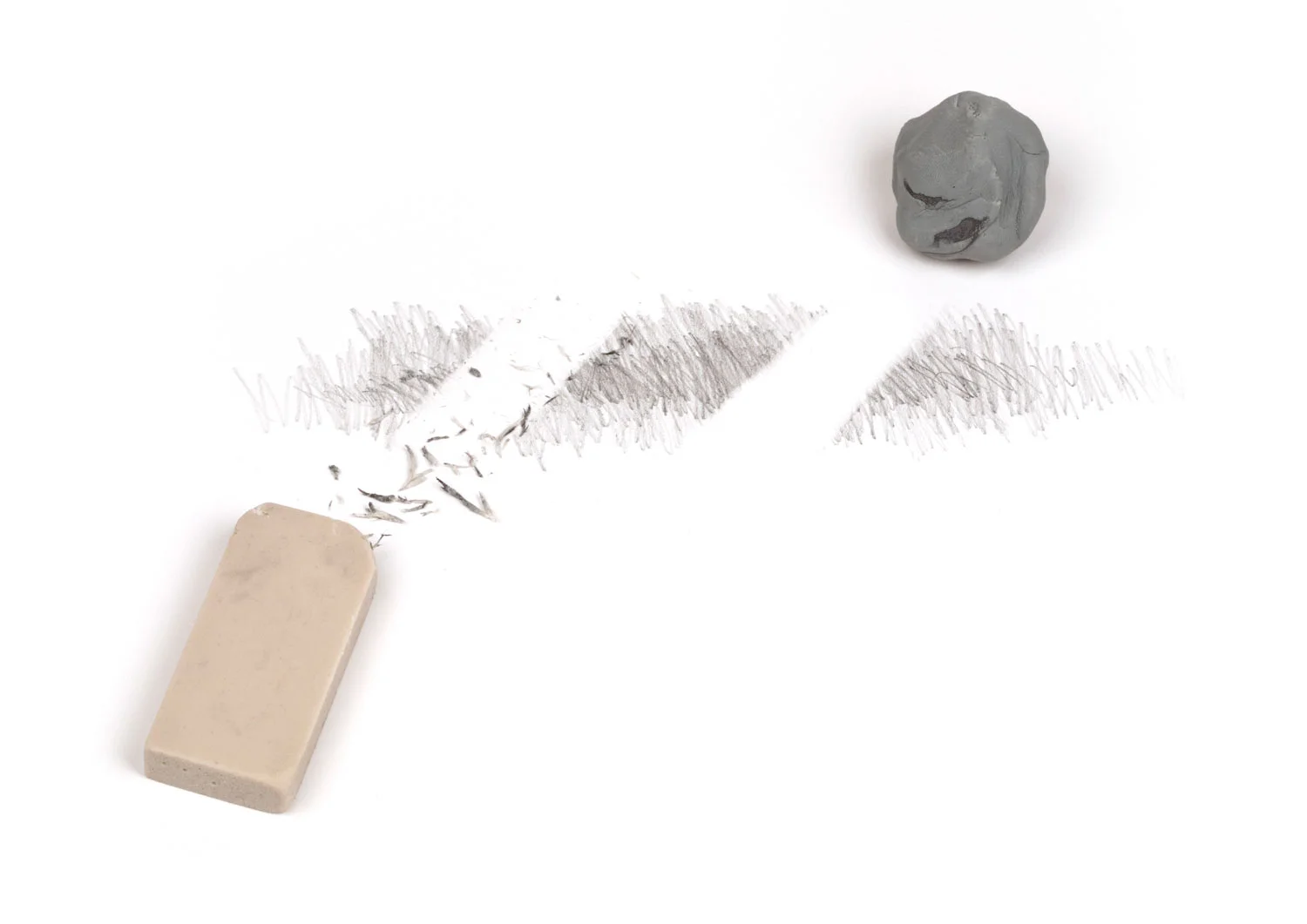
two-types-of-eraser
 

What does it look like when you fix a mistake? Let’s consider erasers for a moment.

Hard, rubber erasers are good for removing tone. They can strike a clean, sharp line. They can be used aggressively. However, there’s a lot of mess afterwards. Eraser dust. Like tiny crescent rolls of rubber and graphite.

Kneeded erasers (putty rubber) are different. They’re gentler in the way they remove material, and they don’t create dust. Instead of degrading with use, kneeded erasers absorb the graphite or charcoal. Over time, they darken in color, but they tend to last longer than hard erasers.

* * *

So what happens when you make corrections? When you take care of an error? When you right a wrong? Do you create a mess that has to be blown away and cleaned up later?

Perhaps you barely leave a trace… fixing things so that they appear to have always been perfect. Making it seem effortless.

As with drawing, maybe the approach you take is quite situational.


Missed a post? Check out the index to see the titles by date.

Blog Index
stephen
How well does your leader see?

Who’s leading you? Who do you follow?

More importantly, what’s that person’s vision vision like? Are you following someone who’s only looking a little further ahead than you? Or are you following someone with vision beyond your own... someone worthy of leading you?

stephen
Cogs

Sometimes, we’re so focused on spinning the cog that is our work... so committed to a practice, that we can forget about the importance of engagement.

That, a disconnected spinning cog just spins.

And we can make that cog spin as fast as we’d like, for as long as we’d like. But by itself, it accomplishes little.

However, when we’re intentional about engagement — when we consciously connect our work to the right people and organizations — then our work can be the driver for change. It can become the heart of a mechanism. Something bigger than what we can accomplish by ourselves.

It doesn’t require more effort — just the right connection.

stephen
Our reputation

The list is short — the people who do one great thing that carries their reputation on in perpetuity.

For most of us, our reputation is built slowly through connection and consistency.

Not through a single grand act, but through thousands of little acts.

So there’s less pressure to accomplish one majestic thing. Instead, we just have to focus on one small thing at a time. One small, virtuous act. And then another. And another.

And little by little, we make our mark in this world, and our reputation takes shape. Slowly, but surely.

stephen
The preview

I presented an award yesterday. In preparing my remarks, I did something I hadn’t done in a long time. We used to call it “videotaping” since that was the technology of the day. These days, smartphones make it much simpler to do.

As I worked with the text, I thought, “I have an opportunity to see what this will look like, before I let others see it. Why not look, and then work on the trouble spots?”

So I did. I took video of myself speaking, and quickly found places to improve.

For instance: in the video, I looked at my notes right before reading my own name. My own name. Clearly, I was too tied to the text.

Without that quick video, I’d have had no idea there was a problem.

The thing is, there are plenty of times I have an opportunity to “preview” my own work. To share a draft before publishing. To take video of a rehearsal.

Most often, however, I just ship. I ship, and then level-up the next time.

But... as I learned in preparing for the award presentation… sometimes I can level-up before the first release. And it’s definitely worth the effort.

stephen
You gotta talk

In team sports, communication is critical. Am I getting the ball, or are you?

Without prompt agreement, the ball drops. The point is lost. The runner scores. The other team takes possession.

On playing fields, communication is brief, and decisions are made quickly. Typically, someone shouts, “I got it!”

In our personal lives, and in business too, we can forget to do this. We can forget the simple act of communicating, “I got it.”

Of course, we don’t always forget. There are plenty of times we take on responsibility.

But just like in sport, if you say “I got it,” you’d better follow that up and make the play.

stephen
Our voice

Did Bukowski ever spend time thinking about how he could write more like Mary Oliver? Probably not.

Is Adele in the studio working on Mariah Carey riffs? Not likely.

As artists and creators, we have our own voices. Our styles change over time, and we certainly experiment. We might even be similar to others. But our voice is uniquely our own.

It’s our voice that we put into the world. Not someone else’s. Ours.

Ours to love. Ours to cultivate. Ours to share.

stephen
Taking a break

When we’re paddling down the river — with its mouth as our destination — it may be tempting to take a break. To stop working toward our goals, just for a little while. To step away from the journey, and onto the river bank.

After all, rest is healthy.

The risk, however, is that we convince ourselves that the river bank is a nice place to stay.

That instead of resting, we set up camp. And we slowly forget that our goal was to follow the river to its end.

Rest when you need to. But don’t stray too far from the boat. You’ve got paddling to do, and goals to achieve.

The river is waiting.

stephen
Personal setbacks

You're not aware of the personal setbacks my doctor overcame this week.

And neither am I.

Because she’s a professional.

* * *

Share your personal struggles with a close friend. Maybe even a trusted colleague.

But in your profession — for the people you serve — be one hundred percent. Make things work magically. Seamlessly.

I’m not suggesting that we deny our own humanity. Or that we bottle things up and ignore personal challenges. Just that we choose the right time and the right venue to share.

Your surgeon. Your pilot. Your legal counsel. They all had perfect weekends, they’re well-rested, and they’re ready to work (from your perspective). Because they’re professionals.

We can be, too.

stephen
Like you do

If someone were to say, “Let's do it like _______ does it,” and your name was in the blank, what would that mean?

What kind of reputation do you have? How do you handle situations? What does a project or event look like when your fingerprints are on it?

It’s worth knowing how you’re perceived.

And if you don’t like the story, over time — little by little — you can change it.

stephen
Unsolicited feedback

Company surveys are frequent to the point of annoyance. “How did we do?” “Do you like us?” “How can we improve?”

And sometimes, we conduct informal surveys of our own. “How was I?” “How do you think that went?” “How do I look?”

Depending on what’s offered, the responses can be useful.

But it’s when unsolicited feedback is given — particularly the positive kind — that’s when we can be truly encouraged.

When someone is so moved by the work we do, that they feel compelled to express gratitude. To articulate appreciation.

That kind of goodness doesn’t come from scripted surveys, check-boxes, and responses motivated by “a chance to win” for participating.

That kind of goodness comes from personal connection and generosity.

When you receive it, embrace it. Soak it up, and then get back to being great at what you do.

stephen
Feeling behind

When we enter a new field, join a new organization, or engage with a new circle of associates, it’s natural to feel behind. But we’re not behind. Not really.

It’s not a straight-line continuum. We’ve merely entered a new room.

We can observe the room, or we can mingle with the people who arrived before us.

We can join existing conversations, or we can start new ones.

In this new field, we’re the fresh face, and there can be great strength in that.

stephen
Not for them

It’s not for them, and that’s OK.

Not everyone has time for your story. Even if it’s a good one.

Not everyone likes the taste of the dish you love to cook. Even if you think it’s delicious.

Not everyone can join you on your journey. Even if you’re great company.

Not everyone is excited about your work. Even if you’re endlessly passionate.

Even your friends. Even your family.

And that’s OK.

It’s not personal.

It doesn’t mean you’re worth less, or that your work is lacking.

It means your work isn’t for them. Or maybe it’s not for them right now.

It’s not for everyone. So who is it for?

stephen
Wants and needs

If we could create a culture where we ensured everyone’s needs, we wouldn’t be afraid to give away our last dollar. Or to share it at least.

But we live in a culture that’s focused on wants, regardless of whether needs are met.

And when we prioritize wants over needs, we can never fully address the needs of others... because our wants — the kind that seem to drive our culture — those wants are never fully satisfied.

stephen
Compliments

What is the best compliment?

The way you answer that question can tell you a lot about what you value, who you strive to be, who you respect, and where your quiet jealousies are hidden.

stephen
Customer service

A short rant about the customer service flow chart. This is the scripted path that agents navigate based on customers’ questions and responses during a call or chat.

My issue is specifically about the end of the conversation. Many of these flow charts end with the agent asking, “Is there anything else I can help you with today?”

They ask this whether they’ve helped or not. Twice, recently, I’ve had interactions where the person on the other end of the line was not able to help me. Not one bit.

And so the question, “Is there anything else I can help you with...” is one that annoys. In these cases, my internal narrator was quick to point out, “You didn’t help me with the first thing.”

Corporations: please. Allow your employees to be human enough to say, “I’m sorry we couldn’t help you today.” Sometimes, it’s the awkward truth. But when that happens, let the cogs in your big machine have the agency to acknowledge it, maybe even with a little bit of personality.

stephen
Living your dream

“My dream is to _______.”

Let’s take a look at that statement. What’s stopping you from living that dream?

Is it impossible? Or does it just seem impossible because it involves change, risk, sacrifice, or uncertainties that you’re not ready to face?

If it’s your dream — truly your heart’s ambition — wouldn’t it make sense to start taking steps towards it?

Yes, those first steps might be challenging. After all, it’s easier to talk about the dream you have for yourself than it is to begin making it a reality.

Or is it? Maybe, just maybe, those steps aren't so difficult... if you can just tell your own fear to take a back seat.

stephen
Waiting for coffee

There’s a Keurig machine in an office where I work. A brew cycle for a 10 oz. cup takes 45 seconds.

Every day, at least one person will set a mug, press the brew button, and then walk away.

The idea — I’m sure — is that he will be able to accomplish some small task instead of waiting idly.

But often, the brewed coffee is forgotten.

Two things to consider:

One, the act of brewing coffee is perhaps what people seek. That it’s an alertness placebo.

Two, there are times when we feel overwhelm to the point that 45 seconds seems too precious to waste.

I offer no advice here, except this: wait for it.

If it’s worth brewing, it’s worth waiting.

stephen