Ask me later

In the series finale of “Game of Thrones” there’s a wise bit of dialogue:

A: Was it right? What I did?
B: What we did.
A: It doesn’t feel right.
B: Ask me again in ten years.

Some decisions play out immediately. Others, in a few years. Still others, in a generation.

When we’ve done our homework and we’ve chosen carefully, we can’t always judge a decision based on how we feel immediately afterwards. Some results take time to unfold.

stephen
Unspoken

I recently lost my voice. After a couple of days, it returned and I was able to speak again. But my singing voice wasn’t in functional shape for more than a week.

Leading up to an event where I was scheduled to sing, I gave my voice a 24-hour rest: no speaking, no whispering, no attempts to vocalize. In a household with family and pets, this was a bit of a challenge, but I made it work.

During that brief stint, I had a worrisome thought: what if I encountered a neighbor? How would I reply if I was greeted? A simple, non-verbal wave? A smile and a gesture toward my throat? Would they understand without further explanation? I didn’t want to seem rude and it’s not like I was wearing a sign or a label.

And that’s just it: for the most part, we don’t wear signs or labels. We just navigate the world with all this stuff going on inside and the outside world has no way of knowing — not unless we explain. And explaining isn’t always simple. Or convenient. Or appropriate.

I’m having a bad day. I’m anxious about a test result. I lost a loved one. I’m preoccupied because of a thing at work. I’m feeling unwell. We all have countless private influences that can pull us below baseline.

The hope is that we’re accepted with kindness. That others tell themselves a story about us that is based on compassion, generosity, and the benefit of the doubt.

It’s an approach that can begin with each of us. It doesn’t even have to involve speaking.
stephen
Courage and ambition

One of my colleagues has adopted a new motto: Be courageous more than ambitious.

What I appreciate about this is its focus on a particular posture rather than an outcome. It’s more about attitude and mindset and less about outwardly visible achievement.

Ambition will take us to various peaks and valleys. Courage will give us the heart to be travelers.

stephen
Sitting with ideas

In Rohan’s January 1, 2025 blog post, he mentions a concept: “Show me the incentive and I’ll show you the outcome.” It’s a Charlie Munger quote and it rings true.

But I didn’t quite grasp it the first time I read it. I was about to move on, then I decided: no, I’m going to ponder this one until I have a better understanding of what it really means. I did just that, and I found the exercise meaningful.

Our culture is filled with quips and headlines, posts and articles. They’re endless. We can become like product inspectors standing next to a continuous conveyor belt. We take a brief moment to consider various items and then it’s on to others.

But we can choose to step away from the conveyor.

We can select topics to consider deeply.

We can cogitate, meditate, and reflect.

We can ruminate, internalize, and share.

The world is moving at a clip. It’s easy to forget that we can pull an all-stop when we decide to pay close attention. And paying close attention is worthwhile.

stephen
Beneath logic

Some choices are obvious. The data, the analytics, the pros and cons — they point to a logical option.

And even with all that evidence, we can still struggle to decide.

Because we’re emotional beings. We have feelings about decisions. And feelings don’t always follow the logic.

The way we think about a choice and how we feel about that choice: they can be miles apart. Sometimes the hard part is bridging the gap.

stephen
Planning for the year

Choose a plan that you think is a good one.

Stick to that plan.

Be patient with the results.

That’s the long and the short of it, isn’t it?

It’s not to be spectacular. It’s not to get lucky. It’s not to do the unreasonable or the untenable. It’s just to make a serious commitment to a thoughtful, reasonable plan. A plan that we ourselves author.

It’s not too much to ask and it’s not too much to do.

stephen
Daily articulation

Slurred speech is difficult to follow. One word blends into another into another. It becomes unintelligible noise.

When life gets busy — or exceptionally uneventful — a similar thing can happen. One day flows into the next into the next. It’s Thursday already? What happened to the beginning of the week?

As articulation is to speech, so are simple journals and logs to life. Brief, intentional notes that mark time. Captured memories to honor the bits and bobs of our existence.

Life will course regardless. Daily moments of reflective attention help us to appreciate the journey as it unfolds.

stephen
Jimmy Carter

We can learn a lot from Jimmy Carter’s example. His impact in the world — particularly post-presidency — is astounding. This quote says much about how he lived:

“I have one life and one chance to make it count for something. I’m free to choose what that something is, and the something I’ve chosen is my faith. Now, my faith goes beyond theology and religion and requires considerable work and effort. My faith demands — this is not optional — my faith demands that I do whatever I can, wherever I am, whenever I can, for as long as I can with whatever I have to try to make a difference.”

A model of integrity and an inspiration to many.

stephen
One spring

“One day, spring will come without her.”

This poignant line is from the delightful novel The Thursday Murder Club, written by Richard Osman.

In this phrase, one of the main characters is acknowledging her mortality, prompting her to enjoy the daffodils by the lake while she’s still there to see them.

It’s a gentler version of the old Latin chestnut, memento mori.

May we all live long lives. But still, best to enjoy the beauty of each season as though it’s the last one we’ll witness.

Seek out the daffodils.

stephen
Learning from zero

I tried a new sport and discovered that I was not a natural. It taxed muscles I don’t often train and required techniques of which I had no knowledge.

Pure strength and intuition did not carry me far.

I looked around: others made things look easy with graceful efficiency.

But I should not have been surprised. I was comparing my zero-hours experience with well-practiced, skilled participants. Not a fair comparison.

Sometimes, even the first few steps can call for domain knowledge and guidance.

And learning new things requires patience and humility.

Be sure to do it regularly.

stephen
Want to play?

We could go bowling, or we could go bouldering.
We could play cards, or we could go for a hike.
We could play basketball, or we could play catch.

Depending on the group, sometimes it’s more fun to choose the activity where we don’t end with labels of winners and losers.

Competition can be a lot of fun. But just playing to play can be a lot of fun for everyone, no matter how things turn out.

stephen
Temporary limits

When we have nothing to say, or when we “can’t think of anything”, or when we’re out of ideas — it’s a reflection of our current mindset. It’s not a reflection of the infinite universe, the availability of ideas, or a lack of inspirational topics — it’s because of a temporary limitation we’ve allowed to take hold in our mind.

We can unlock at will; it’s our choice.

stephen
Half-venue

When an audience is smaller than you expect, it’s tempting to feel a little let down.

Get over that feeling quickly.

Lean in. Double down.

Whatever craft you bring, bring it to the fullest. This is an opportunity for you to shine.

For those who are present, let them experience the best you have to offer. Forget about the “lite” version of you. That doesn’t exist.

When you look at the audience, recalibrate: this group is now one hundred percent attendance. Serve them well.

stephen
The sound of anticipation

In the crescendo that precedes an event, there often comes a moment of stillness. Of holding one’s breath. A collective pause.

Anticipation can prompt a host of activities and emotions. We prepare personally and socially in many ways.

But with heightened anticipation — as we draw near — we experience a kind of quiet.

There’s a pause in conversation. A settling of movement. A silent watchfulness. A focused attention.

And like a symphonic caesura, life then resumes and carries forward. Anticipation, pause, release. Preparation, yield, continuation. Like respiration, it’s the natural way of things.

stephen
Listening in the present

It’s so important to be thoughtful. To consider — ahead of time — what you’ll say, how you’ll perform, the way you’ll act.

Yet when we do this too intensely in real-time, we miss what’s right in front of us. We’re pulled out of the present, lost in our own thoughts.

To be so sure that we’re responding clearly and from the heart … that we’re not fully listening to the person who’s speaking to us. Or to be so concerned with our own performance that we’re not listening to the other actors. This balance is suboptimal.

Our brains are always thinking, always calculating. The job is to tune our ears and to direct our attention. Our words and actions (from our heartfelt intention) they will serve us well at the right time. Don’t miss too much of the present in consideration of them.

stephen
Incarceration

It might not happen with stone and iron, glass and steel, but many are incarcerated.

Information, gossip, entertainment, attention, food, status, distraction, achievement …

Prisons of our own making.

When we can free ourselves, we are free indeed.

stephen
Trial and error

It’s curious that the phrase is “trial and error” and not something else. We don’t say, “trial and success” or “error and solution”. It’s just trial and error, which sounds like an endless loop of frustration.

Perhaps it keeps our expectations measured, which is a good thing. Because trial and error is a valuable part of the creative process and fully worth our time. We just have to remember that error is part of the process and not always the end result.

Trial and error is just the opening act. The rest of the play is about learning, growth, and viable solutions.

stephen
Invisible hard work

On the one hand, we value hard work. Industrious and hard-working — these are compliments in our culture. We are people who strive.

We want others to be hard workers, too.

At the same time, we give a lot of credit to people who “make it look easy”. We value confidence, style, and a perceived effortlessness.

It’s a curious dichotomy (hypocrisy?) that can be overlooked.

Work hard, but don’t look like you’re working hard.
Push past your limits, but don’t look wanting.
Put in a lot of effort, but make it look effortless.

These unspoken expectations can weigh heavily.

When we more openly accept that struggling can look like struggling, trying can look like trying, and hard work can look like hard work — the more generously and effectively we can endeavor together.

stephen
Signage

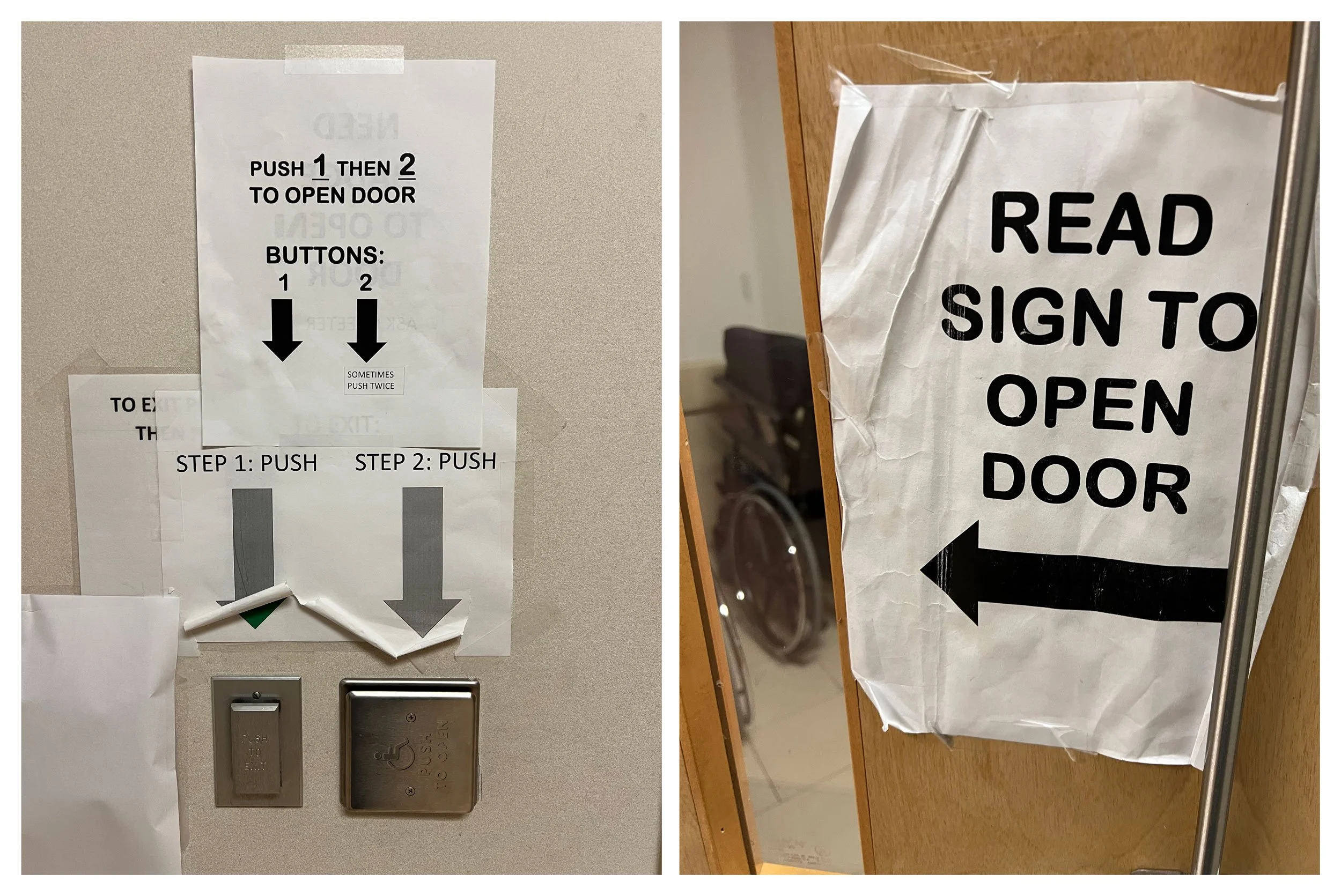
Exiting a local healthcare facility, you’ll encounter these signs:


The quality of paper, layers of tape, and version history tell a story.

Firstly, exiting through these doors is not intuitive. Secondly, the prescribed way is not guaranteed to work. Thirdly, we haven’t figured out how to make this easy. Maybe we need another sign?

* * *

Good user design is often invisible. It requires no labeling, no signage, no instructions. The design is self-instructive.

A clearly-worded, well-placed sign can solve some headaches. (The PUSH sign affixed above the pull handle, for example.) But even obnoxiously visible signs don’t always override instinct.

It’s a cautionary tale. Arrows and labels are imperfect solutions to flawed design. Wherever possible, begin with thoughtful design.

stephen
Wintry inspiration

Leroy Anderson began writing Sleigh Ride — the wintry orchestral standard with the clip-clop horse sounds, the crack of the whip, and the trumpet horse whinny — during a heat wave in July, 1946.

Our surroundings can inspire us — both for what they are and for what they are not. By what we see and by what we long to see.

When something in the universe seeks expression, it can do so independent of seasonal changes.

stephen