
“I can take it.”
This is a healthy approach to handling criticism.
The important question that follows — which we don’t always consider — is this:
Where are you going to put it?
“I can take it.”
This is a healthy approach to handling criticism.
The important question that follows — which we don’t always consider — is this:
Where are you going to put it?
If you hear a dripping sound and you look up to see a wet stain on the ceiling, it’s natural to think there’s a leak in the room above.
Possible, but not a guarantee.
Water travels. Water entering a roof on one side of a building may travel down the interior of the walls and across the spaces between floor and ceiling before dripping into a room. A leak on the east side may turn into a drip on the north side.
Lots of problems are like this; the source isn’t what we immediately see, and it’s not even on the other side of what’s in front of us.
Sometimes problems have distant sources. That’s useful to remember whether we’re considering a water ring on the ceiling ... or a power outage, or a drought in the American west, or a manager in the next office.
To find the source, we sometimes have to look far and deep.
Historical figures — whether heroic or hateful — are often remembered by only a few moments or by a single, defining act.
For the rest of us, we’re remembered by countless moments — big and small, clear and foggy — all woven together in the memories of our loved ones.
Part of our call — as humans — is to witness. To see others.
But it goes beyond seeing, lest it remain observation or entertainment.
No. Beyond seeing it is seeking to connect. To understand. To value.
We are called to share laughter. To share tears. To celebrate and to mourn.
* * *
Words often help us to embrace our connections, but where words fail ... presence does not.
Simply holding space together — gathering — can connect us in joy and in sorrow ... even when the script falls short.
When you’re building a house, do you choose standard lumber to construct the walls, or do you source exotic logs and mill the pieces on your own?
When you’re brewing tea, do you purchase cups for serving or do you throw them yourself on the potter’s wheel?
When you’re starting a company, do you use existing HR software or do you build the tools from scratch?
At every point in a project, we have the choice between standard and special.
We need “special” to build something remarkable. But inevitably, there will be areas where standard inputs will still contribute to beautiful outputs.
Not every project has the scope and the budget of the Palace of Versailles. Even that were so, working without constraints can lead to mediocrity.
How and were we choose between standard and special can often affect the impact of our work and how it’s remembered ... or forgotten.
In secret, do you indulge or do you persevere?
When no one is looking ... are you more disciplined or more lazy? Intentional and focused ... or checked out?
It’s often what we do in private that influences the long arc of our lives.
Among others humans, a nine-year-old and a five-year-old boy live in my house.
The phrase “I’m telling!” is occasionally shouted from another room. Perhaps you can imagine brothers acting in this way.
When they shout, “I’m telling!” the idea is that, “When Mom and Dad find out what you’ve done, you’ll be in trouble.”
But it’s not always the case. “Telling” doesn’t always prompt action to be taken.
This happens more broadly, too. We think, “If only they knew about this problem, someone would do something.”
And yet. Hunger, inequality, injustice, and corruption persist. We know about it. We see it. Someone has told us. We’ve told someone. But action isn’t always taken.
So many times in our world, knowing isn’t enough. Telling isn’t enough.
Said another way, when major problems exist and action needs to be taken, “telling” is not sufficient action. It’s a necessary first step, but it’s only the beginning.
The sky is blue and the clouds are white.
Until they’re not.
Until the sky is golden yellow and the clouds are purple. Or one is orange and the other is magenta.
Art is often about seeing, and seeing is often about suspending our prejudices and assumptions and allowing ourselves to freshly experience what awaits our senses.
What we find can often surprise and delight.
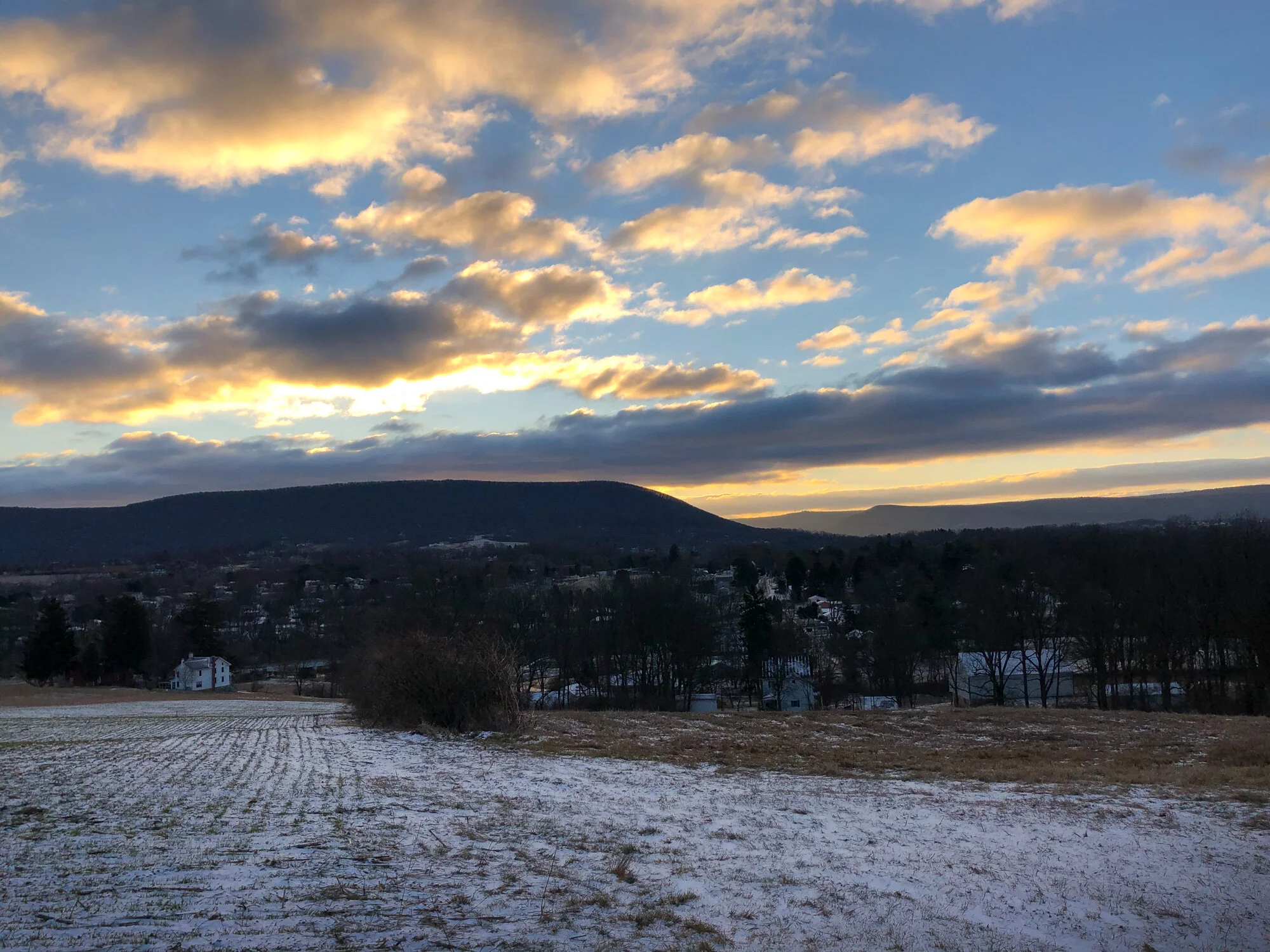
State College, Pennsylvania. January 17, 2020.
This is the time of year that I step back (as subtly as possible) when someone coughs near me. If something contagious is going around, I’d just as well not catch it, thank you very much.
Some things, however, are worth catching. Generosity. Empathy. Creative drive. Excitement. Resilience. Purpose.
The challenge is to spread these things if they’re not spreading on their own. To make these things contagious.
How can we spread what we think is worth spreading? How can we encourage others to embrace what we think is worthwhile? How can we make it easier to share what’s share-worthy?
Today, we’re more connected than we’ve ever been in the history of humankind. We have the ability to spread the ideas worth spreading, but we have to choose to do so.
I glued a project recently. Spreading the glue was a bit complicated and it involved some time constraints.
As I put the pieces together, I focused on one area to make sure it was aligned. My focus was so intense that I didn’t notice another section that had shifted out of alignment. By the time I noticed it, there was no opportunity for adjustment.
No worries; I was able to trim off the excess without too much trouble.
Satisfied that I had corrected the problem, I observed my work ... only to realize that I had glued the entire element upside down.
* * *
This happens. Sometimes we’re so focused on one thing, that an equally important (or more important) other thing is overlooked.
We’re focused on the text and we forget to make sure the people in the back can hear us. We’re focused on the food and we forget the utensils. We’re focused on the departure time and we forget to make sure we have all our bags.
At any moment, we can become too narrow in our focus ... at the expense of other things that should be in our view.
We need to pause from time to time to make sure we haven’t missed something important. And of course, backing up to assess the big picture is best done before the proverbial glue has dried.
The goal is not to eliminate tension.
The goal is to release the tension that holds us back, and to embrace the tension that propels us forward.
We need tension … we just need the right kind of tension.
Being present in a meeting can be challenging. Digitally, there’s always someone knocking at the front door. Always someone in the waiting room. Always someone who wants our attention.
It’s our responsibility to temporarily mute those channels. To focus on what’s in front of us. To bring our full attention to the task at hand, and to those who have gathered to meet.
If those topics and those people don’t require our full attention, then our presence at the meeting is only marginally useful. It may be that our time will be best spent elsewhere.
And if that’s not true — if our contribution is indeed needed — then it’s time to set aside distractions and to be fully present.
Yesterday, I watched a mother — with a fluidity that made it seem unconscious — place her hand over a sharp corner as her toddler crawled near a bench.
Had he stood up, his head would have met her hand, not the hard wood.
It made me think of my own journey. I know of many times when people have helped me ... but surely there have been many other times when friends have been ready to help, just in case.
And we can do this too. Being conscious of others. Seeing them for who they are and where they want to go. And being ready to help where we can, should a friend begin to stumble.
To extend a hand when we see another in potential danger ... that’s a dynamic that doesn’t have to be limited to a mother and child.
There’s enough attention. Enough resources. Enough opportunity.
Enough — that you can share. That you can be generous. That you can point to others. That you can help someone else turn the ratchet in their own journey.
Zig Ziglar famously said, “You can have everything you want in life if you help enough other people get what they want.”
Our world is big enough and plentiful enough that we can give selflessly, and still gain what we ourselves seek.
Your temporary discomfort may be an everyday reality for someone else.
Your moment of aggravation may be commonplace elsewhere.
You might experience times of fear, but there are some who live in fear.
* * *
There’s a complex world outside of our own surroundings — a world of which we are a part, if only because we are other humans sharing this planet.
As much as we can, may we cultivate empathy and seek positive change.
My oldest son plays baseball, and he occasionally works with a batting coach. The coach focuses on teaching the segmented fundamentals of a good swing. Once that’s ingrained, a full swing can be practiced.
Here’s one notable part of the coach’s teaching: during practice (following warm-up) he advocates for a 100 percent swing, every time. As hard as you can swing the bat while maintaining proper technique.
Not 90 percent. Not 95 percent. Always 100 percent.
What I’ve observed is that my son needs occasional reminders. Even knowing the objective and thinking about 100 percent, he will drift to somewhere below that mark.
And every so often, amidst the “Good,” and “That’s it!” I’ll hear the coach ask, “Was that as hard as you can go? Can you swing harder?”
Most often, the answer is yes.
Here’s the lesson: even with the best intentions, we occasionally need to ask the question, “Was that my best?” or “Am I giving 100 percent?”
Our auto-pilot runs somewhere less than 100 percent. To be our very best, we need to be conscious and intentional, and to periodically check: Is that as hard as I can go? Can I swing harder?
Many times, the answer is yes.
What exactly does it mean to have a good day?
Is it an uninterrupted string of goodness? That seems like asking a lot of 24 hours.
What if just part of the day is good? Maybe the morning was bad, but the evening was good. Is that a good day? Does the opposite sequence work?
Perhaps good moments scattered throughout the day ... surely that would be a good day. Right? But what if it ends on a sour note?
What about a great day? How many great moments make for a great day?
There are no clear answers, of course. There’s only the story we tell ourselves, and the way we respond to ever-changing circumstances.
The question is this: upon what will you dwell? What will you hold in your mind? Which fleeting moments will you hold in your heart?
The answer will likely tell you if you’ve had a good day.
If it’s dark and you feel like you’re suffocating, it can feel a lot like you’re buried.
But it’s also possible that you’re on the verge of growth. That you’re not buried, dead ... but planted, alive.
That this moment is one of germination. Of transformation.
If you’re within a season of darkness, it may be a sign that you’re growing.
In digital spell-check, there are often three options for a flagged word: correct, ignore, or add to dictionary.
In the world, what do we do when we encounter something that’s different than what we had expected? How do we handle differences in worldview, gender, and attire, for instance?
Are we biased toward “correcting” what we see, assuming that what’s different is wrong?
Do we ignore the difference, moving on as though there’s nothing to notice?
Or do we “add to dictionary”? Do we accept as correct as-is, and seek to learn and to understand?
I often encourage generosity. Giving without counting the cost or expecting a return.
But there’s another side to this: allowing people to be kind and generous to you.
It can be humbling, and maybe a little uncomfortable, but in order for us to create a culture of generosity, we have to allow ourselves to be on the receiving end of it too — to allow someone else to give, and to receive gratefully.
And graciously accepting a generous act can be a kind of gift if its own.