
Making do

When things go awry, we have a choice between “make do” and “make known”.

Some of us work within unexpected constraints and produce magic with what we have. And things often appear to have been planned all along.

Others like to make it known that some problem has occurred. Someone has screwed up, or nature has happened, and “here’s all we could come up with.”

Thing is, we can often make do without drawing attention to all the hurdles we’ve masterfully navigated.

And the people who make do in this quiet way … they’re more likely than not to “make beautiful” while they’re at it.
stephen
500th post

Today marks my 500th daily blog post. I’ve been looking forward to this milestone as a kind of badge of honor, but the closer I’ve come to it, the less I’ve been interested in it.

500 posts is not a goal. It never was. This activity of shipping daily, of trying to be generous with creativity, of trying to speak something of value into the world ... this an ongoing practice. It’s a commitment to a particular posture.

It’s often said: it’s about the journey, not the destination.

Here’s my take: we have an opportunity to enjoy the act of journeying ... to experience the rewards of leaning into who we are and how we hope to be in this world. And that’s to play an infinite game where the joy isn’t found at the end of a long road. Rather, we can find joy daily, and even carry it with us as we go.

stephen
Sounding the horn

I watched a car slow its pace. It meandered with some uncertainty. The brake lights illuminated near every cross street.

A frustrated driver who was closely following the lead car leaned into his horn. Beeeeeeeep.

Some considerations:

Does this kind of honking ever work? Does it ever help someone to find their way? Does it ever bring clarity to the situation? Does mere honking on these occasions effect positive change?

(If you’re reading this as a metaphor, that’s a fine thing to do.)

stephen
Forgetting your gear

When an athlete gets to the game unprepared, it’s obvious.

When you don’t have the team jersey, or a water bottle, it’s clear to you and others: you don’t have with you what you need.

But there are other things we forget — inside and outside of sport — that are not as apparent.

A positive attitude. Empathy. A spirit of cooperation. Patience.

When you get to the locker room without your gear, you know you’ve made a mistake. You know what you have to correct.

Much harder to recognize that you’ve shown up to the conference without patience. Or that you’ve arrived at the office without empathy.

Putting a gym bag by the front door will help you to remember your critical equipment. The challenge is figuring out how to remember all those invisible things that are just as important.

stephen
Filters

Digital filters are everywhere.

Photo filters are the norm. Video can be easily filtered in real-time. Vocal filters and voice-changers are a thing too.

These settings are all at our fingertips. Press a button, apply a filter.

What we don’t have, however, is a button to push to make our ideas better.

We can’t simply apply effects to an idea to make it some version of beautiful.

Ideation and innovation still need our intellectual and emotional commitment. We haven’t automated, “make my idea better.” That’s still going to take the magic that’s born of the creative process.

stephen
Layered beauty

There’s a beautiful quality to a densely layered oil painting. It has nuance and variation. Physical richness. Even the highest quality printing process cannot replicate the layered luminosity created through glazes and scumbling.

Longtime friendships are like this. They have a particular depth and presence that cannot be duplicated. Strong bonds built over time ... through closeness and distance, joy and sadness, and everything between.

Friendships like these ... cherish them like a priceless work of art.

stephen
How you say it

Writing daily gives me an opportunity to be more conscious of my style and my habits.

I tend to use lots of commas, ellipses, and dashes in order to hint at how I’d say the text aloud.

I’ve noticed that some phrases are frequent flyers too, like the words “of course”. I typically say “of course” when I mean, “this may be obvious, but it’s worth pointing out explicitly.”

There’s some irony here. In a literal sense, “of course” means “of the ordinary course of events” or “according to the expected program or path”. Meanwhile, I’m more inclined to encourage us to step off the path — to be off course — or at least to consider how we can create change by flirting with what’s near the guardrail, or even beyond it.

stephen
Two plumbers

It took me three weeks to get on a plumber’s schedule. When he arrived at my house, I said, “Wow. You guys are really busy.”

His reply was telltale and flat: “‘s because no one wants to do this kind of work.”

Implied, of course, was that he didn’t want to do it either.

I don’t blame him. Plumbing work can be foul, complicated, and physically demanding. But I couldn’t help considering the story this plumber tells himself: “I’m stuck doing a job no one else wants to do.”

Years ago, I knew another plumber whose attitude was quite different. Same jobs, same customers, but a different mindset. His was, “I’m an everyday hero. People have a problem, and I have the skill-set and mental toughness to fix it. Maybe not glamorous, but absolutely critical.”

I can’t speak for the happiness of either plumber, but one carried his tool bags as though they were twice as heavy.

stephen
Hope for change
 
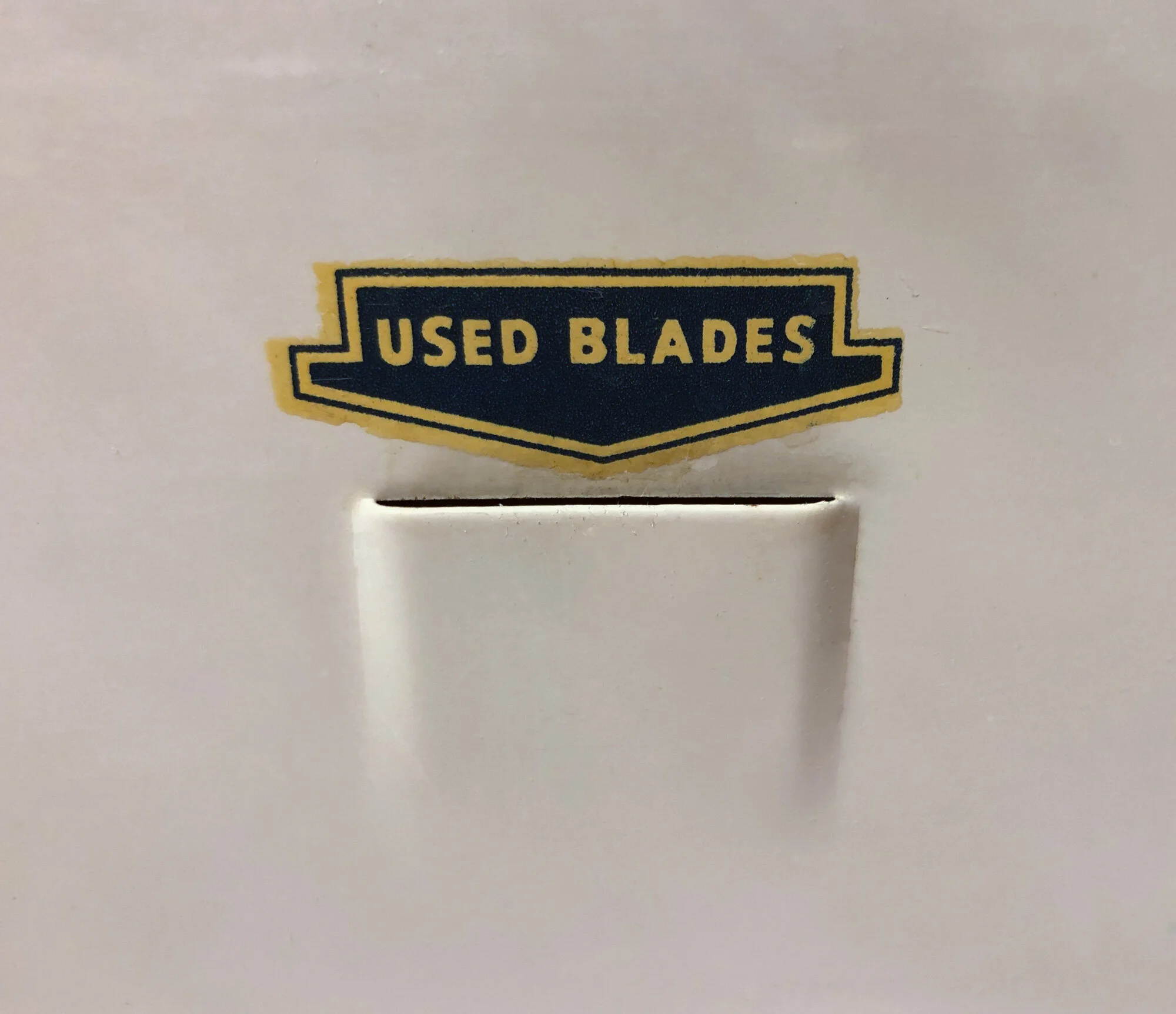
insert-used-razor-blades.jpg
 

Many old medicine cabinets have a slot in the back that says “used blades”.

For me, this tells a hopeful story. That one generation’s solution for dull razor blades was to drop them into a wall cavity, and that a newer generation finds the obsolete practice ridiculous and dangerous.

No, we haven’t solved all the world’s problems ... even when it comes to disposable razors. But we can change our ways. It often takes innovation and cultural shifts, but we can change.

We can see what prior generations have done, and we can make better decisions. That we no longer fill our walls with hazardous trash ... that’s one small example of forward progress.

Much has been done, but there is so much left to do.

stephen
Splints

Put a splint on one of your fingers and some routine activities may become difficult. A small change in digital mobility can turn simple tasks into awkward challenges.

What we sometimes forget is that we’re surrounded by people with splints. And we have them too. Hidden areas of brokenness that we’ve plastered over. Places where injury has caused us to become immobile. Parts where we’re healing, but not yet whole.

The point here is not to diagnose.

The point is to understand.

To have empathy, and to appreciate the many challenges that can come with injury and healing — challenges that can present themselves in all sorts of ways … which can then become challenges of their own.

stephen
New skills

A friend of mine is learning some new skills. He was interested in trying something, so he found some courses online, and got to work learning.

It really is that easy.

Is the learning part easy? Not necessarily. It might even be quite challenging.

But the act of setting out to learn something new ... that’s certainly easy.

Of course, we don’t always tell ourselves that story. We have a list of reasons why we can’t do certain things, or why there’s no time to study a new craft, or why following our passion is impractical or impossible.

But that’s a voice we can silence. Or better yet, a voice we can replace with a new one that says, “You want to try something new? Awesome. Go for it!”

stephen
None of your business

I heard an amusing perspective on gossip.

“If it’s none of your business, it’s none of your business.”

Often, we’ll hear, “Well, it’s none of my business, but — “ And what follows is surely a conversation about what’s been presented as not the speaker’s business.

Worth considering: if it’s none of your business, maybe it really is none of your business. Perhaps best to leave it be.

stephen
Name cards

I attend a regular meeting where we use name cards. These small signs sit on the table in front of each of us and help with member identification.

A colleague sitting beside me thought that her card was backwards, but quickly realized that our names are printed on both sides.

We laughed, “Some days, we need that reminder!”

It was a joke, but there’s some truth in it. Some days, we do need a reminder of who we are. A reminder of our worth. A reminder that our existence is consequential, and that our name can be a beautiful reference to all that we are, all that we do, the story of our past, and the promise of our future.

You are you, and that matters.

stephen
Trying and prioritizing

When someone says, “I’ll try to get it done by next week,” it’s not often that they mean, “I’m not sure if I’m capable of this task, but I will do my best.”

No. What they usually mean is, “I can do this, but in order to accomplish it by next week, I’ll need to prioritize it over other things ... and I’m not sure I’m ready to do that.”

So when we hear, “I’ll try,” we might really be hearing, “I’ll try to prioritize,” which is another way of saying, “I’ve got to convince myself that this is important to me.”

stephen
Knowing or learning?

I recently heard someone say, “I know all about [this].”

What a fascinating posture.

I wonder how things might be different if this person had the attitude of:

  • I’m always learning about ...

  • I’m a lifelong student of ...

  • I’m endlessly curious about ...

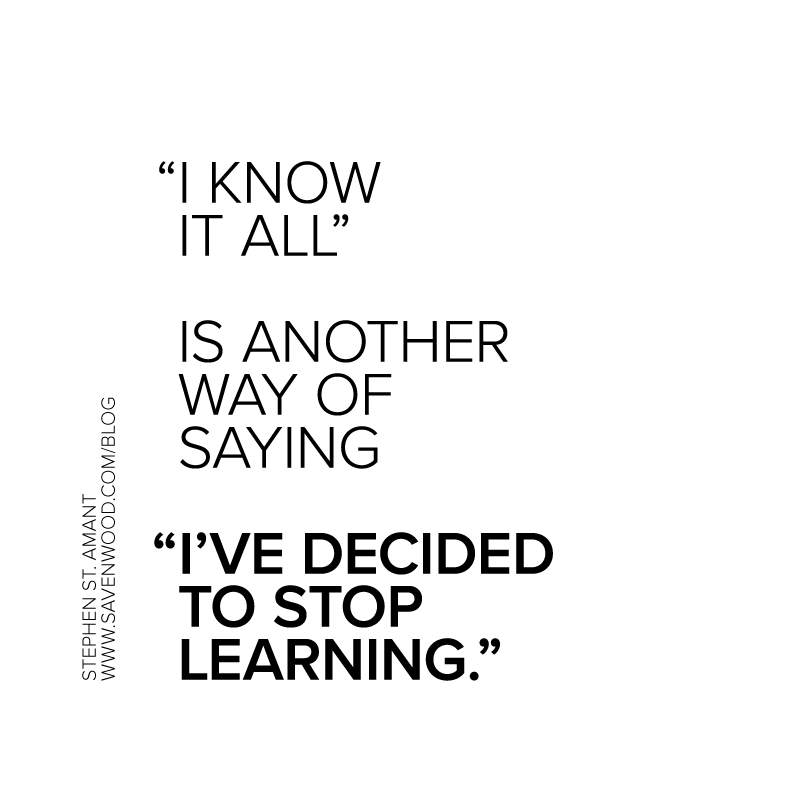
When we say, “I know it all,” what we’re really saying is that we’ve made the unfortunate choice to stop learning.

stephen
Outsiders and insiders

Some of the most engaging art is born of those whose foundations are external to the arts.

Art has always embraced innovation. It makes sense, then, that creators coming from the outside — people not steeped in history, techniques, and tradition — would be in a perfect position to innovate. To provide fresh ideas. Fresh perspective.

It’s this way with many cross-disciplinary pursuits. Fresh vision doesn’t just come from seasoned experts thinking about what’s next. Sometimes the future path is charted by a new source.

In each of our fields, it can be wise to welcome the outsider who sparks new ways of thinking.

stephen
Caught trying

We don’t like to fail. We avoid it skillfully.

But aside from failure, some of us also don’t like to be seen struggling. To be seen trying.

We’d rather practice quietly, and then show up perfect. Fail privately until we can shine publicly.

But what if that mindset keeps us in hiding? What if we’re so afraid of being seen as less-than in public, that we never venture there?

What happens if we become comfortable with the idea of others seeing us trying? With allowing others to see us stumble?

Wouldn’t we grow faster that way? Yes, we might get a few bumps and bruises along the way, but those will heal. (The critics never linger as we improve.)

And over time, we’ll certainly get better. More expert. And we won’t have to wonder what people will think when they see what we do — we’ll already be out there in the open, doing our thing, doing it well, and always getting better.

stephen
Choosing

If being nice isn’t natural for you, then make it a choice.

If you don’t tend to be generous, then choose to be generous.

If there are natural tendencies holding you back, it’s time to intentionally choose a better way forward.

stephen
Planting seeds

Seeds that are planted cannot be seen. They’re underground. Out of site. Invisible.

What does this mean for us?

It means that the beginning stages of our best work sometimes seem fruitless. That there is no immediate harvest. That at first, the benefits may be unseen.

But just like planted seeds, our work doesn’t remain invisible forever. Over time, it bears fruit ... and it grows into visibility where it feels the warmth of the sun and continues to blossom.

stephen
Trophy room

I don’t have a physical trophy room, but I have a mental one. We all do. Memories of our wins and accomplishments. A catalog of our successes — moments when we’ve been at our best.

But we also keep an internal room of our failures. A room that’s often given more space and more light.

It doesn’t benefit us to curate this collection of disappointments, and yet it’s easy to find ourselves in that room taking detailed inventory. Replaying the past as if it was yesterday.

Here’s the thing. We have a limited amount of light to shine. Perhaps we’ll always have a flame burning in the room of our defeats, but let’s move as much light as we can into that other room ... the room that commemorates our victories — the times we’ve soared to our greatest heights.

Tend to that room, and let it encourage us as our journey continues.

stephen