Sooner than later

Via email, I suggested to a colleague that we should take action on an item “sooner than later”.

But before I sent the message, I made an adjustment.

The new text — “today or tomorrow” — established a goal, and it’s the target I intended to suggest.

“Sooner than later” was a doughy, noncommittal signal that the action was unimportant.

* * *

Setting a clear timeline isn’t about being pushy; it’s part of being effective.

stephen
Managing email

Read, file. Read, delete. Read, delete. Delete. Delete.

Email is a part of life, and it’s plentiful. So much so that we have to have strategies to manage it.

I’ve lately considered the problem of processing my email versus the potential alternatives.

How often do I read something and sit with it? Let it soak in? Meditate over it?

I follow a few insightful blogs. Do I read those words and let them marinate, or do I scan and file?

* * *

Every day, we will encounter wisdom. If we’re not paying attention, it might pass us by ... just like the rest of the noise we’ve filed away.

stephen
Movement

If you’re feeling small and unseen, maybe you need to move a little more.

During a walk the other day, I wouldn’t have noticed a bird except that it swooped across the path. Had it been still, I never would have seen it.

In contrast, superstars can usually be seen just by showing up. They’re big enough. They have a reputation. They’re noticeable standing still. A bull elk — compared to the bird in a tree — is not likely to be missed.

But for most of us, we’re more like the bird. Standing still is akin to invisibility. We need to move to be seen.

Which prompts the question: What’s the movement you’re creating?

stephen
Pirouette

At a daycare Halloween event, parents gathered to watch as the children were recognized for their costumes.

Most memorably, a three-year-old girl who was dressed as a ballerina ... upon being called to stand up ... performed an extensive spin. All the parents smiled, ooh-ed, and ahh-ed. It was wonderful.

Was she asked to do it? No.

Did she have to do it? No.

Should she have done it? Absolutely.

Go ahead. Give a twirl, just because you can.

Yes, this is a metaphor ... but you can take it literally too.

stephen
Not seeing it

One of my sons has partial color blindness.

On a recent rainy day, he was looking for rainbows. There, in the foggy distance, was the makings of one. It remained low on the horizon, not extending far into the otherwise cloudy sky. Nonetheless, there it was. Reds, yellows, violets. A little green.

“Look, buddy! There it is!”

He couldn’t see it.

Hard as he tried, my son couldn’t see the color.

I explained where it was. Pointed to it. Described what I was seeing.

It was something about the daylight and color saturation; my son just couldn’t see what I saw.

We moved on ... looking for beauty in other places. Beauty we could see together.

* * *

And so it is. There will be times when we want to see something, and we desperately try … but to no avail. Even if it’s right there in front of us.

Do we give up looking?

No. Instead, we practice patience. We try to see another way. Or we seek other places, where there are different conditions and the lighting is just right.

Just because we don’t see it right now doesn’t mean we won’t ever see it.

Keep looking. Keep seeking.

stephen
Sound mixing

We’re the sound engineers sitting at the mixer. We have the sliders and knobs at our fingertips.

It’s up to us to turn up the internal voices and narratives that are helping ... and to mute the channels that are dragging us down.

The negative lines — for the most part — will always be present. We can’t disconnect them completely. But we do have great control over their levels.

What we amplify and what we mute ... is our choice.

stephen
Wearing masks

We all wear masks to varying degrees, and not just on Halloween. Some masks are to meant to keep us safe. Some are meant to project status.

But if we’re spending a lot of time tending to our masks, couldn’t we spend that time tending to ourselves instead?

If we shore-up our confidence ...

If we cultivate our friendliness ...

If we hone our professionalism ...

We will have less need for those masks, and we can freely interact with the world as ourselves.

stephen
Performance gap

How big is the gap between your usual good work, and the very best you can do?

What happens when we intentionally try to narrow that gap ... or eliminate it completely?

stephen
Focal point

While a young girl spoke to the audience, her father was recording video on his phone.

I could see his screen, and I noticed that the camera lens was focused on the podium ... not on his daughter. She was slightly out of focus while the podium was perfectly sharp.

Sometimes we’re in the right place at the right time, and we accidentally focus on the wrong thing. This happens both literally and figuratively.

And so it’s useful to pause from time to time to consider: what’s important here, and where am I focusing my attention?

stephen
Finding the good

Instead of being a flaw-finder, what if we tried to be a good-finder?

Instead of seeing shortcomings, what if we just looked for the good?

And what if we did this all week?

Or we decided to make it an ongoing practice?

This isn’t just a rhetorical musing; it’s a proposal.

stephen
Bad drafts

If you can’t write a good draft, then write a bad draft.

Write a few bad drafts.

The path to strong work often travels through weak iterations.

* * *

We don’t produce good work by pausing production until the work is good.

We produce good work by starting where we are, and shipping … and then doing it again, and again.

If you can’t start strong, then start weak. But you’ve got to start.

You don’t get better by hiding.

stephen
Fear

Fear will feel like a threat ... until you invite it to dance.

Then, everything changes.

You might not know all the moves. But the more you dance, the better you’ll get.

Don’t run from fear; dance with it.

stephen
I have time for this

Fill in the blank. “If I have time for _______, then I should have time for _______.”

When we don’t pay attention, our day can be very porous. Things that aren’t important can enter and take the place of what should be there instead.

It’s our job to have a wider vision. To prioritize. To choose what earns time in our day, and what does not.

Don’t let it happen passively. Make a choice based on what matters.

stephen
Offering help

“I can help with that.”

That phrase doesn’t carry much weight if you don’t follow through.

Unless you add a “here’s what I’ll do” and a “here’s when I’ll do it” ... saying, “I can help” is mostly just noise.

Of course you can help. Everyone can help. But what will you do, and when?

stephen
Giant portraits

The story I’ve heard is that in the 1960s, when Chuck Close was painting over-sized, photo-realistic portraits, a critic tried to discourage him.

“Galleries and collectors don’t want these portraits. No one is doing this kind of work.”

Close was undeterred. His reply was something like, “Good. I’ll be the only one.”

And indeed, Chuck Close became famous for his giant portraits.

* * *

Finding ourselves alone, or out on the edges ... that can be a good thing. There, we have space to grow. Space to make marks that are our own.

By contrast, the center is crowded. It’s hard to be noticed by being more in the center than everyone else.

But the edges? The edges are great places to explore. We might even find a voice that we can call our own.

stephen
Bench warming

Come off the bench.

This is your life and you’re a starter.

You’re not here to warm the bench. You’re not a backup.

You’re the main attraction.

Get out there and play.

stephen
Appreciation

They know how much you appreciate them. No need to say it out loud. They already know.

Or maybe they don’t know. Maybe what you’ve assumed is wrong, and they have no idea how you feel.

Just to play it safe, you’d better say something ... regularly.

stephen
How do you lean?

Do you lean in with curiosity? Or do you lean back with judgement?

Do you lean in with empathy? Or do you lean back with apathy?

Do you lean in with courage? Or do you lean back in fear?

Just like walking, the way you lean determines the direction you’re going.

stephen
Green grass

We can spend a long time thinking about how green the grass is on the other side of the fence.

Or we can tend to the grass under our feet, which can be made lush by the work of our hands.

We can be preoccupied with gazing over the fence, or we can get to work making things better right where we are.

The choice is ours.

stephen
Daily goal

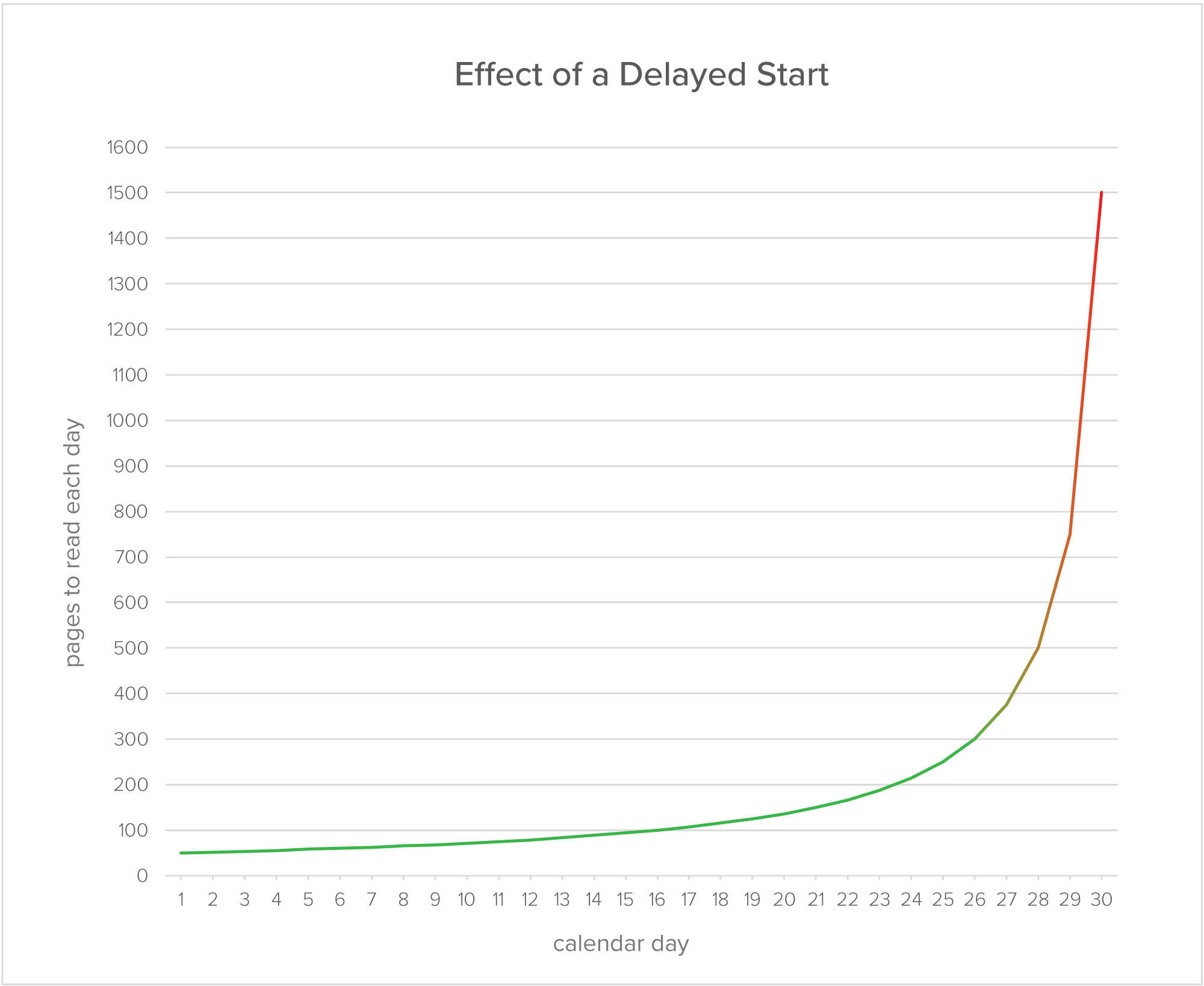
In preparation for a month-long workshop, I had a pile of books to read. 30 days to prepare, and about 1,500 pages to consume. I set a goal for reading 50 pages every night.

After a week, I was slightly behind schedule. I re-calibrated to 56 pages per night.

A little later, I had fallen behind again, and ramped up to 62 pages.

When I had two days left, I still had 300 pages remaining: 150 pages each night.

What I realized was that for the first part of the month, even if I was far below my daily goal, it wouldn’t take much additional work to make up the lost ground.

But toward the end of the month, things changed substantially. With time compressed, the burden increased significantly each day.

Take a look at this graph showing how those 50 pages per night would have played out if I had delayed. If I had procrastinated, it wouldn’t seem so bad at first … but it would get tough eventually.

Sure, it’s simple math. But for me, seeing consequence of falling behind — seeing it so clearly — helps me to remember: a little bit each day goes a long way. Little by little, drip by drip.

Whether it’s reading, or exercising, or practicing a skill … whatever it is, the cost of delaying isn’t noticeable at first. But it can add up.

Let’s work each day so that big number goes in the “what I’ve done” column, and not the column for what’s left to do.
 
delayed_start.png
 
stephen