
Fear will feel like a threat ... until you invite it to dance.
Then, everything changes.
You might not know all the moves. But the more you dance, the better you’ll get.
Don’t run from fear; dance with it.
Fear will feel like a threat ... until you invite it to dance.
Then, everything changes.
You might not know all the moves. But the more you dance, the better you’ll get.
Don’t run from fear; dance with it.
Fill in the blank. “If I have time for _______, then I should have time for _______.”
When we don’t pay attention, our day can be very porous. Things that aren’t important can enter and take the place of what should be there instead.
It’s our job to have a wider vision. To prioritize. To choose what earns time in our day, and what does not.
Don’t let it happen passively. Make a choice based on what matters.
“I can help with that.”
That phrase doesn’t carry much weight if you don’t follow through.
Unless you add a “here’s what I’ll do” and a “here’s when I’ll do it” ... saying, “I can help” is mostly just noise.
Of course you can help. Everyone can help. But what will you do, and when?
The story I’ve heard is that in the 1960s, when Chuck Close was painting over-sized, photo-realistic portraits, a critic tried to discourage him.
“Galleries and collectors don’t want these portraits. No one is doing this kind of work.”
Close was undeterred. His reply was something like, “Good. I’ll be the only one.”
And indeed, Chuck Close became famous for his giant portraits.
* * *
Finding ourselves alone, or out on the edges ... that can be a good thing. There, we have space to grow. Space to make marks that are our own.
By contrast, the center is crowded. It’s hard to be noticed by being more in the center than everyone else.
But the edges? The edges are great places to explore. We might even find a voice that we can call our own.
Come off the bench.
This is your life and you’re a starter.
You’re not here to warm the bench. You’re not a backup.
You’re the main attraction.
Get out there and play.
They know how much you appreciate them. No need to say it out loud. They already know.
Or maybe they don’t know. Maybe what you’ve assumed is wrong, and they have no idea how you feel.
Just to play it safe, you’d better say something ... regularly.
Do you lean in with curiosity? Or do you lean back with judgement?
Do you lean in with empathy? Or do you lean back with apathy?
Do you lean in with courage? Or do you lean back in fear?
Just like walking, the way you lean determines the direction you’re going.
We can spend a long time thinking about how green the grass is on the other side of the fence.
Or we can tend to the grass under our feet, which can be made lush by the work of our hands.
We can be preoccupied with gazing over the fence, or we can get to work making things better right where we are.
The choice is ours.
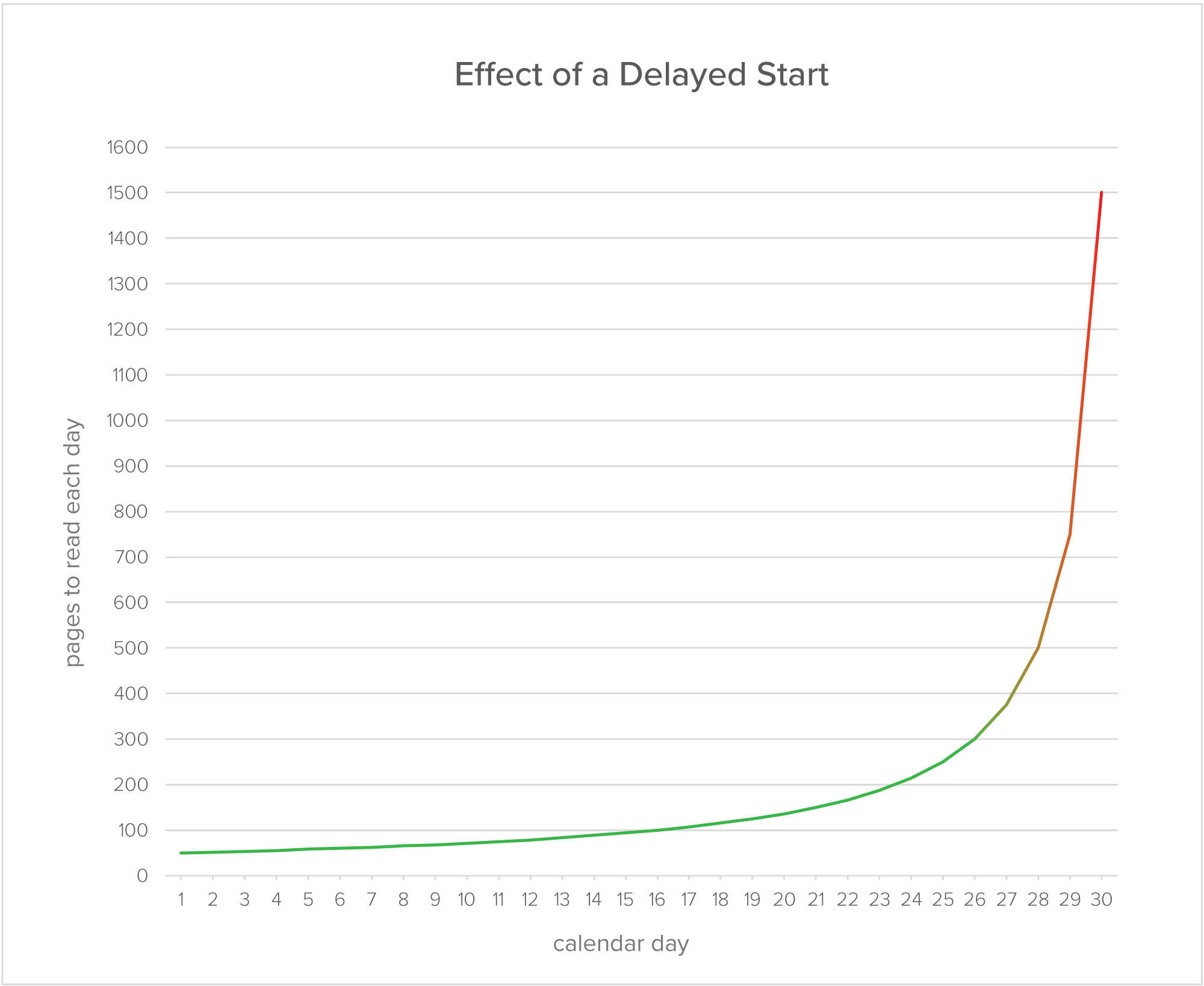
In preparation for a month-long workshop, I had a pile of books to read. 30 days to prepare, and about 1,500 pages to consume. I set a goal for reading 50 pages every night.
After a week, I was slightly behind schedule. I re-calibrated to 56 pages per night.
A little later, I had fallen behind again, and ramped up to 62 pages.
When I had two days left, I still had 300 pages remaining: 150 pages each night.
What I realized was that for the first part of the month, even if I was far below my daily goal, it wouldn’t take much additional work to make up the lost ground.
But toward the end of the month, things changed substantially. With time compressed, the burden increased significantly each day.
Take a look at this graph showing how those 50 pages per night would have played out if I had delayed. If I had procrastinated, it wouldn’t seem so bad at first … but it would get tough eventually.
Sure, it’s simple math. But for me, seeing consequence of falling behind — seeing it so clearly — helps me to remember: a little bit each day goes a long way. Little by little, drip by drip.
Whether it’s reading, or exercising, or practicing a skill … whatever it is, the cost of delaying isn’t noticeable at first. But it can add up.
Let’s work each day so that big number goes in the “what I’ve done” column, and not the column for what’s left to do.
When you’re a leader ... your mood, your attitude, and your disposition set a tone.
People act — consciously and unconsciously — in response to how you act.
If you see that the group dynamic is not working, check on the tone your’re setting.
And here’s a secret: if you’re not the leader, and you choose to set a new tone that serves the group ... you automatically become a leader.
Write something in ink.
Not pencil.
Ink.
Commit to it.
Publicly.
Something you believe in.
And keep your word.
Then do it again.
The way you tell (or ask) someone to wait lays a foundation for their experience of waiting.
I called two competing companies recently. Each greeting was followed by on-hold music. Here’s what I heard:
Call One: “[Company Name] Hold.”
Call Two: “Hello! Thank you for calling [Company Name]. This is Barbara. Can you please hold for a moment?”
Afterwards, I used a stopwatch. The first way to answer takes two seconds. The second way takes four seconds ... five if you count my reply.
Is the first company so busy that they can’t afford those extra three seconds to answer the phone in a courteous way? Of course, during my hold, I had plenty of time to ponder the way the phone was answered.
The three seconds saved might have bought the employee some time, but it came at the cost of my positive feelings toward the brand, and ultimately my patronage.
And the second company? I was happy to hold for Barbara ... and she was just as friendly when she picked up again.
When you’re turning screws — particularly the cross-slotted variety — you have to push the driver into the head of the screw.
Interestingly, it doesn’t matter whether you’re loosening or tightening. Either way, positive engagement is needed for the driver to work.
It’s the same with any kind of change that we try to make. We need to lean in.
Sometimes it takes a little pressure. Sometimes it takes a lot.
But one thing is certain: no engagement ... no change.
So go ahead. Lean in.
Most of the time, you’re not going to get credit for trying.
But you do get something. You get experience. You get the opportunity to learn. You get the thrill of doing something that might not work.
And you get to flex your persistence muscle, which will get stronger over time.
Credit or no, your willingness to try is worth something. It might even turn out to be worth a lot.
The person behind the desk asked, “Can I help you?”
I replied, “Maybe. I’m not sure if I’m in the right place.”
This happens sometimes, too, in an existential sense. We look around and we wonder, “Am I in the right place? Is this where I’m supposed to be?”
And there might be people along the way who help us to answer that question. But when our vision is clear, we can help others. We can choose the generous act of noticing someone doing right and saying, “I see you. You’re doing a good thing here.”
Or the more generous act of offering, “If it’s not here, then where is it that you want to go? I will do what I can to help you get there.”
When I was in high school, I remember writing reminders that I’d tape across my bedroom door jamb at night. Things like “biology homework” or “library book” or “linseed oil”. When I woke up, I couldn’t leave my room without seeing the reminder.
Making a morning routine of checking a list in a notebook would have been a more refined system. Probably would have been a better habit to develop. But for fifteen-year-old me, the taped sign worked.
Today, I use different tools for reminders. Whether it’s analog or digital, the important thing is to find a system that works. If the tools and methods you’re using aren’t helping you to accomplish your goals, find new tools and new methods.
Let’s pretend that we have a legitimate claim on what the weather is supposed to do.
Even if that were so (and it’s not) how much is our surprise or disappointment going to change the precipitation?
The rain is just as wet when it’s predicted as when it’s unexpected.
So when it rains, don a slicker and pull out an umbrella ... or get wet. Don’t spend much time worrying about what the weather was supposed to do. Like so many things out of our control, it does what it will. What we can control is what we do once we see the raindrops.
Is this another metaphor? Yes. I think so.
There’s a difference between speaking, texting, typing, and writing longhand. A difference in the way the words are formulated and expressed. A difference in the way the words are received.
Part of this has to do with tradition. Part of it has to do with technology and its availability. Speed of delivery plays a role too.
Some sound advice: make a clear choice about the media with which you communicate ... based on what you’re communicating and what you’re hoping to accomplish. The method matters, and there’s a big difference between what’s satisfactory and what’s best.
I’ve often written about being intentional. But while we try our best to be thoughtful and deliberate, there are many times we’re not.
The reality is … many times, people are not intentional. Including us.
It’s a mistake to assume that others are always intentional in what they do and say. They’re not.
This is not to suggest that people aren’t accountable for their words and actions. Rather, it’s a reminder. Sometimes that long, detailed story we invent — the one about what’s going on inside someone else’s head — sometimes we get that story wrong.
Win or lose, when the play is over, we get ready for the next play.
And if it’s the end of the game, we get ready for the next game.
And if it’s the end of the season, we get ready for the next season.
And if it’s the end of our career, we get ready for the next career.
And if it’s the end of our long journey, we get ready for the journey beyond.
It never ends with the win or the loss. It’s always about getting ready for what’s next.